Branded vs Non-Branded Keywords: Which Drives More Growth?

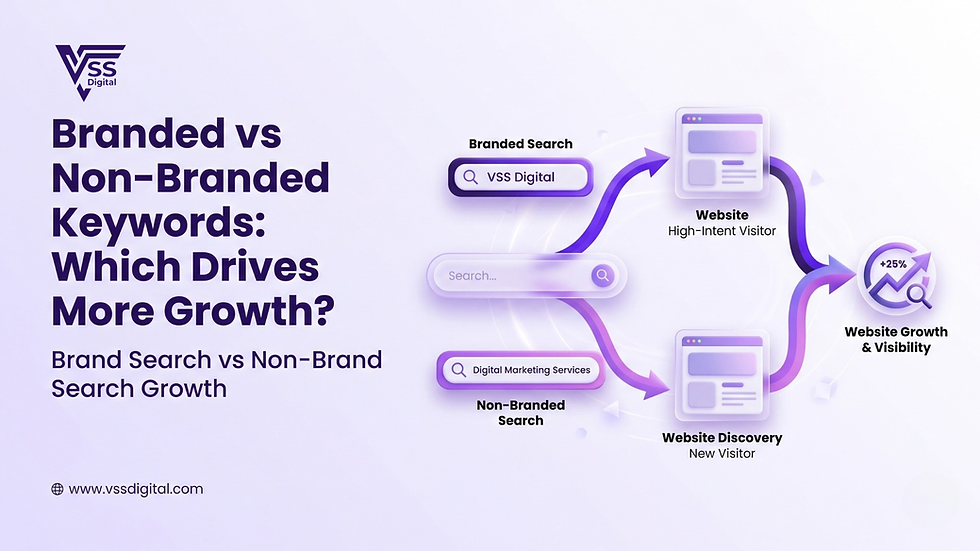
If you've ever looked at the data in Google Search Console at any point and wondered why some keywords bring you tons of traffic and others bring you tons of clicks, you've encountered one of the biggest discussions in SEO: branded vs non-branded keywords. For B2B business owners, CEOs, and marketing managers, understanding this difference isn't just a technical SEO issue; it directly affects how you allocate your budget, forecast, and drive growth.
In this article, we'll break down brand vs non-brand search, review real conversion numbers, and show you how to balance both for sustainable business growth.
What Are Branded and Non-Branded Keywords?
Before comparing performance, it helps to define the two clearly. Each serves a different stage of the buyer journey, and mixing them up in your SEO strategy usually wastes budget.
Branded Keywords
Branded keywords include your company name or product name — think "VSS Digital SEO services" or "Salesforce pricing." These searches come from people who already know you exist and are actively evaluating or ready to buy.
Non-Branded Keywords
Non-branded (or generic) keywords describe a need without naming a company — "best digital marketing agency in Hubli" or "SEO services for startups." These capture demand from people who haven't decided on a provider yet.
Brand Search vs Non-Brand Search: Key Differences
Here's how the two compare across the metrics that matter most to decision-makers:
Factor | Branded Search | Non-Branded Search |
Search Intent | Transactional/Navigational | Informational/Research |
Average Conversion Rate | 5–8% | 2–3% |
Traffic Volume | Lower, high intent | Higher, ~80% of organic traffic |
Cost-per-Click (Paid) | Lower, less competition | Higher, more competitors |
Funnel Stage | Bottom of funnel | Top/middle of funnel |
Business Role | Captures existing demand | Creates new demand |
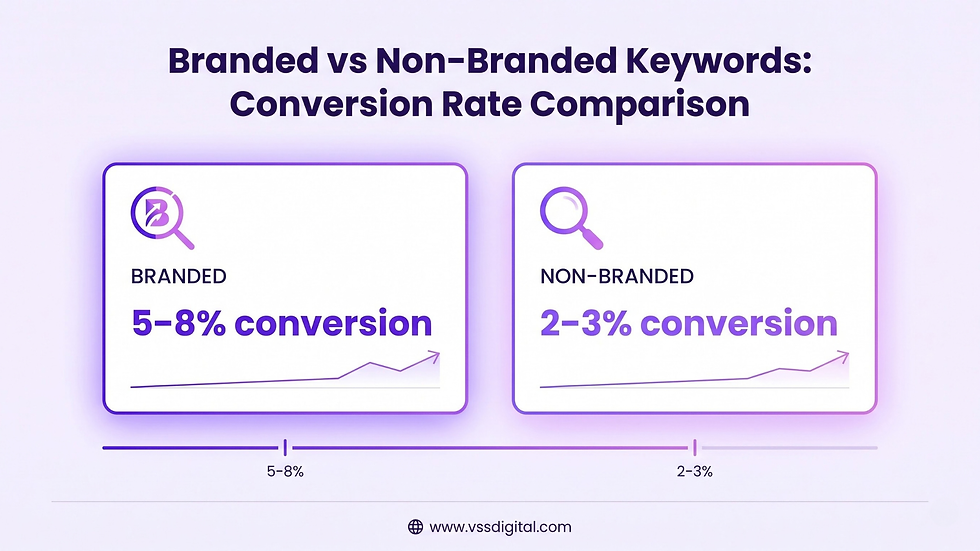
Conversion ratio for branded traffic is 5 to 8%, while that of non-branded traffic is 2 to 3% due to the fact that branded searchers have more intention to make a purchase than non-branded. This matters because it's the difference between keywords that close deals and those that merely build awareness.
Branded Keywords Conversion Rate: The Numbers That Matter
The branded keywords conversion rate advantage isn't just anecdotal — it shows up consistently across industries.
Industry data typically places branded query conversion rates between 4% and 8%, compared to 1% to 2% for non-branded terms — meaning branded intent converts roughly 2 to 5 times better.
Branded search typically converts 2 to 3 times higher than non-branded search, with SERP click-through rates often averaging around 50%.
In B2B specifically, marketers spending 82% of their Google Ads budget on non-branded terms saw a Return on Ad Spend of just 68%, while branded campaigns using only 18% of the budget delivered a 1299% ROAS — nearly 19 times more efficient.
These numbers explain why branded search feels like "easy money." But there's a catch: brand search is a finite resource. It only grows when your other marketing efforts — content, PR, referrals, paid awareness — build recognition in the first place.
How Branded and Non-Branded Keywords Work Together for Business Growth
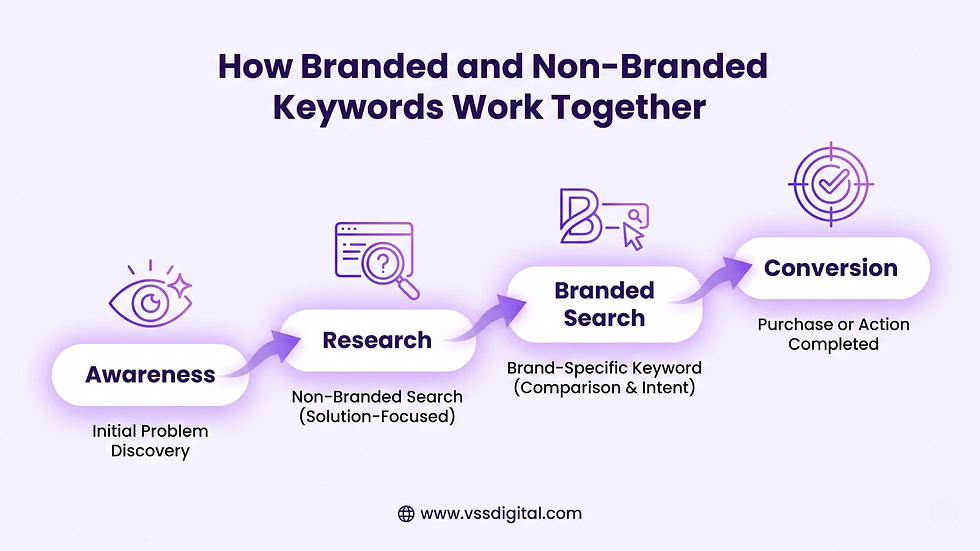
Here's how branded and non-branded keywords work as a system, not as budget competitors.
The Funnel Perspective
Non-branded search brings in people who've never heard of you. Non-branded traffic accounts for approximately 80% of all organic searches, making it the primary channel for new customer acquisition. Branded search then captures those same people later, once they've shortlisted you and are ready to convert.
A Real Example
The US outdoor retailer increased traffic from sources other than its own brands by 15% with relevant camping and hiking content, resulting in a 22% increase in new customers. An increase in non-brand traffic also adds to the brand's search volume, as the more people are exposed to the brand, the more they will begin to search for the brand by name.
For a digital marketing agency in Hubli, India, or anywhere else in India's growing SME and startup ecosystem, this two-stage approach is exactly how sustainable SEO traffic and business growth compound over time.
Common Mistakes Businesses Make
Treating branded and non-branded performance as a single combined figure, which can hide each channel's true efficiency.
The investment in unbranded content is being cut since it 'converts less', even though its role in creating future brand demand is not taken into account.
Ignoring competitor bidding on your branded terms, letting rivals steal high-intent clicks.
Not tracking branded vs. non-branded traffic separately in Google Analytics 4.
Best Practices to Balance Brand and Non-Branded Strategy
Segment reporting — track branded and non-branded traffic, conversions, and ROAS separately.
Invest consistently in non-branded content (blogs, guides, comparison pages) for long-term demand generation.
Guard your branded SERP by using FAQ pages and product pages that rank higher than those of your competitors and third-party sites.
Build topical authority by using non-branded keywords, since this is something that search engines and AI platforms recognize and reward.
Reinvest a portion of branded search savings into expanding non-branded content coverage.
Pro Tips from VSS Digital
Run an incrementality test before assuming you need to bid on your own branded terms in paid search.
Map content clusters around non-branded, informational keywords your ideal client is already searching for.
Review branded search volume growth quarterly — it's a leading indicator of brand awareness success.
Actionable Checklist
Segment GA4 traffic into reports for branded and non-branded
Review current keyword mixture for dependence on one type
Create 3 to 5 pieces of non-branded content focused on funnel-top intent
Establish protection from branded SERP (FAQs, review pages)
Monitor branded keyword conversion monthly
Key Takeaway: While non-branded search helps to expand your audience, branded search is what turns that audience into customers. Companies that regard these two types of searches as part of a single, integrated system rather than as separate budgets achieve the best long-term business growth.
Conclusion
There is no one champion in the battle of the branded vs non-branded keywords debate – because they aren't really rivals. Non-branded search is how your business is introduced to potential new customers, whereas branded search is how they find you once they know you. The real driver of growth is having both building at the same time, with visibility and ongoing commitment to each.
FAQs
1. What is the main difference between branded and non-branded keywords?
Branded keywords are the ones that include a company or product name, and non-branded keywords are the ones that indicate a need or product category, but not a particular brand.
2. Which converts better — branded or non-branded search?
Branded search usually results in conversions that are 2 to 3 times higher because users already know and trust the brand before they search.
3. Should a business stop investing in non-branded SEO?
Non-branded search accounts for about 80% of organic traffic, and it's essential for reaching new customers who haven't heard of your brand yet.
4. How do branded and non-branded keywords work together for growth?
Non-branded search serves to increase awareness and bring in new potential customers, while branded search targets that same audience when they're ready to convert.
5. Is branded search cheaper in Google Ads?
Branded keywords usually have less competition and a lower cost per click, making them more budget-efficient in paid campaigns.
6. How can I track branded vs non-branded traffic?
You can use Google Analytics 4 with tools such as SEMrush and regex-based segment filters to classify and report on both types of traffic.
7. How does a digital marketing agency in Hubli, India approach this balance?
VSS Digital is a strong local agency that creates non-branded content for awareness and protects branded SERPs for conversion, so it can drive awareness and conversion at the same time.
Ready to turn your SEO traffic into real business growth?
VSS Digital helps B2B companies, startups, and SMEs build a balanced keyword strategy — combining branded search protection with high-impact non-branded content that attracts new customers. Contact VSS Digital today for a free SEO audit and custom growth roadmap.

Comments