How to Turn Customer Questions Into a High-Converting Content Strategy

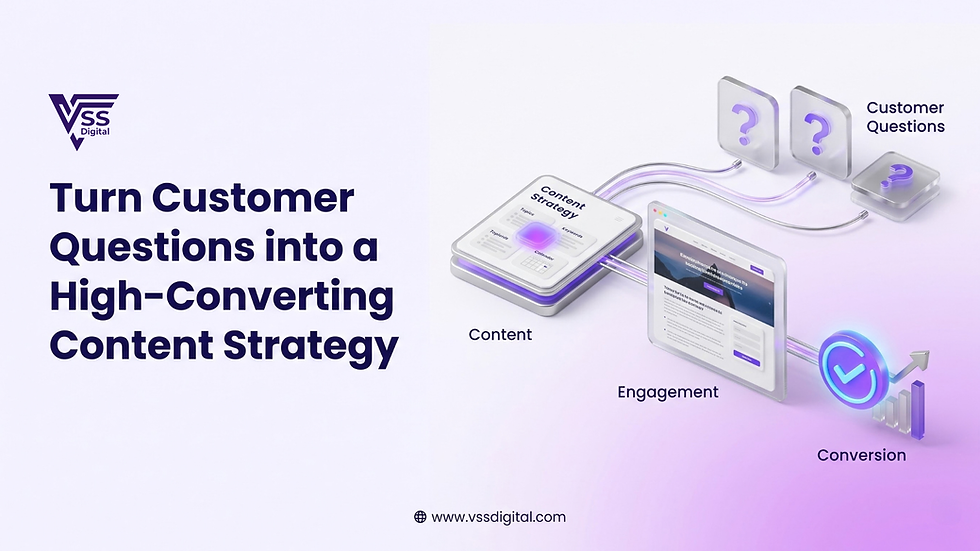
Each day, your sales team is asked the same five or six questions during calls, the same doubts appear in your support inbox, and the same objections are posted in your LinkedIn comments. While most companies regard this as ordinary noise, savvy ones see it as a valuable source of content.
A customer questions content strategy flips the usual approach to content marketing. Instead of guessing what topics might rank, you build content directly from what real buyers ask before they sign a contract. This isn't just a nice-to-have anymore — it's how modern B2B buyers actually research vendors.
Why Customer Questions Are the Smartest Content Strategy for 2026
Here's a number worth remembering: B2B buyers now complete roughly 67% of their buying journey before ever speaking to a salesperson, working through an average of 13.4 pieces of content first. That means your website — not your sales team — is doing most of the convincing.
If your content doesn't answer the actual questions buyers are typing into Google, LinkedIn, and even ChatGPT, you lose that silent buyer before they ever pick up the phone. This is exactly why a content strategy based on customer questions works better than guessing "trending topics." It meets people exactly where they already are — mid-research, mid-doubt, and mid-decision.
What Is a Customer Questions Content Strategy?
A customer questions content strategy is a content planning method where every blog, video, or landing page starts from a real question your prospects or customers ask — not from a keyword tool suggestion list.
Rather than producing a list titled 'Top 10 Digital Marketing Trends', you should put forward the question 'Why isn't my LinkedIn content generating leads?' — since that is precisely the question a frustrated marketing manager types into Google at 11 PM.
This method works because it reflects how high-converting content strategy frameworks will be built in 2026—content that addresses a specific problem people search for, and that will rank ahead of general thought-leadership rubbish almost every time.
Why This Matters More for B2B in India
Indian B2B buyers — SaaS founders, agency owners, IT service leaders — are increasingly self-educating before contacting vendors. Globally, content marketing generates up to three times more leads than traditional marketing formats, with longer-lasting results. Buyers who've already read a dozen generic blog posts notice instantly when your content repeats the same recycled claims as everyone else's.
How to Create Content From Customer Questions: A 5-Step Framework
Here's exactly how to create content from customer questions — the process VSS Digital uses for clients across SaaS, professional services, and B2B agencies.
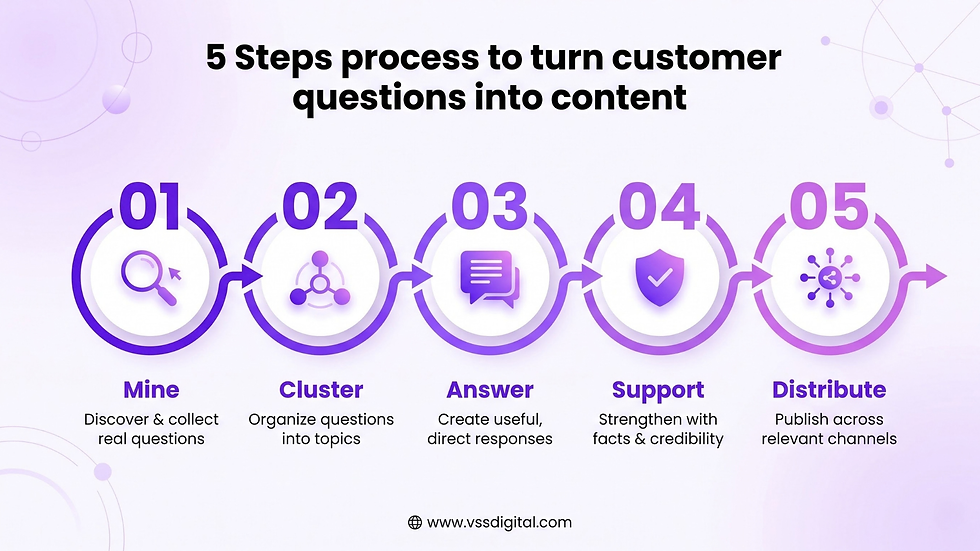
Step 1: Mine Questions From Every Customer Touchpoint
Start with your own data, not a keyword tool.
Transcripts of sales calls – the objections raised on all discovery calls
Support ticket history and live chat history – confusion points raised
LinkedIn comments and DMs — the questions people ask publicly
Google's "People Also Ask" boxes — appear on nearly 20% of all searches
Google Search Console — the exact phrases already driving impressions to your site
Step 2: Cluster Questions by Buyer Intent
Group raw questions into three buckets:
Intent Type | Example Question | Content Format |
Informational | "What is a content strategy?" | Explainer blog |
Commercial | "Best digital marketing agency in Hubli, India" | Comparison/listicle |
Transactional | "How much does SEO cost for a startup?" | Pricing/service page |
This is when the topic ideas generated from the customer’s search queries become an actual editorial calendar and not just any collection of random topics.
Step 3: Write One Definitive Answer Per Page
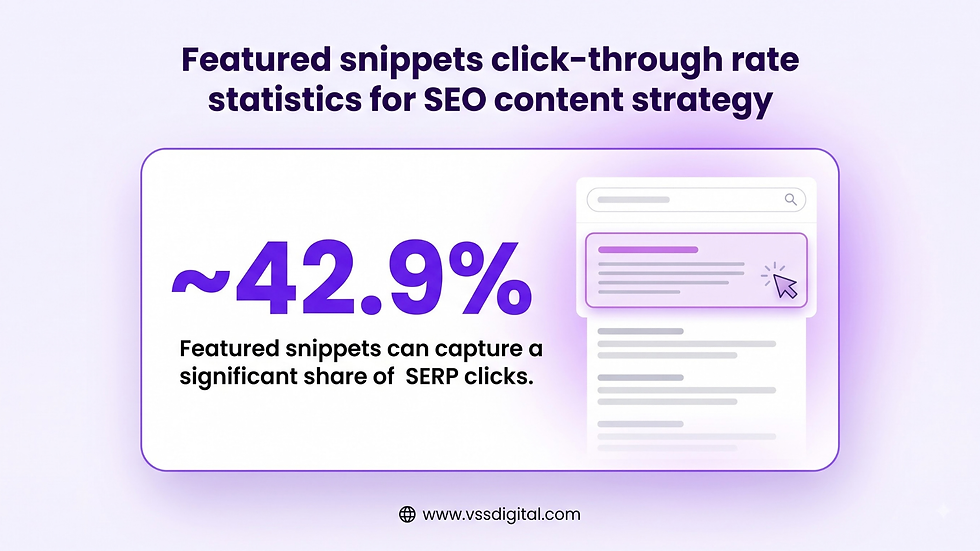
Google's Featured Snippets reward direct, structured answers. Pages that win a featured snippet see click-through rates around 42.9% of total clicks on a search results page — noticeably higher than a standard first-place listing.
For the first 40-60 words under the H2, answer the question.
Use numbered steps, tables, or short bullet lists.
Then add more details, examples, and nuances.
Step 4: Support With Real Numbers and Examples
Insights in number form:
Businesses without a documented strategy report far weaker results than those with one — a 1.7x difference in reported success, roughly matching CMI's gap between documented and undocumented B2B programs
Blogs perform far better at capturing leads than brochures
Long-tail pages created around questions have less competition for ranking than shorter, more generic head terms
Real example: A SaaS company headquartered in Bengaluru found that potential customers often asked during support calls, "Why is our trial-to-paid conversion so low?" They took that question and turned it into an in-depth guide tailored to that phrase; within four months, it became their most effective landing page because it addressed a question buyers were actually searching for on Google, not one the marketing team had assumed people would ask.
Step 5: Distribute Through Social Media Marketing Strategies
Publishing isn't the finish line. Repurpose every question-based article into:
LinkedIn carousel that breaks down your answer in 5 slides
A short video answering the question in under 60 seconds
An Instagram/X thread using the same H2s as talking points
Smart social media marketing strategies recycle one strong piece of question-based content into a week's worth of distribution instead of creating from scratch every time.
Common Mistakes to Avoid
Guessing on questions rather than looking them up — assumptions rarely align with real search intent
Optimizing search engines, not people — unnatural keyword stuffing with the main keyword only hurts readability and rankings.
Ignoring "People Also Ask" data — a free, constantly updated source of real buyer questions
One-and-done publishing — never updating an answer as the market or product changes
Skipping internal linking — orphaned pages rarely rank, no matter how good the answer is
Best Practices and Pro Tips
Best practices:
Update your top question-based pages every 4–6 months
Match one page to one primary question — don't cram five answers into one post
Add FAQ schema markup so your answers are eligible for rich results
Pro tip: Ask your sales team to forward you one recurring question every week. Over a year, that's 50+ ready-made content ideas — sourced directly from paying customers, not guesswork.
Actionable Checklist
Retrieve the top 20 sales call questions from last quarter
Export Search Console queries with high impressions, low clicks
Group questions based on informational, commercial and transactional intent
Write one definitive answer per question, snippet-optimized
Include an internal link to two or three related service or blog posts
Repurpose into one LinkedIn and one short-video asset
Key Takeaways
A customer questions content strategy turns real buyer doubts into ranking, trust-building content. It works because buyers now do most of their research silently—through search, not sales calls—and content built from real questions matches that behaviour far better than guesswork ever can.
Conclusion
Your customers are giving you a free content calendar — every day, through the questions they ask. The businesses getting the best visibility and trust in search in 2026 are not the ones with the most content. They’re the ones with the right content: answers to questions real buyers are already asking, written for both Google and human readers.
Start small. Take ten real questions from your sales team this week, write one truly useful answer to each, and see how much better that content performs than your usual guesswork-driven blogging.
FAQs
1. What is a customer questions content strategy?
It crafts blogs and pages around the actual questions customers and prospects ask, instead of hypothetical keyword guesses.
2. How do I find the right customer questions to target?
Pull data from sales calls, support tickets, LinkedIn comments, Google's "People Also Ask," and Google Search Console — these reveal exactly what real people are asking.
3. How many questions should one blog answer?
Ideally, one primary question per page. This keeps the content focused and improves your chances of winning a featured snippet.
4. Does this strategy work for B2B and SaaS companies?
Yes — it's especially effective for B2B and SaaS, where buyers research extensively before ever contacting sales.
5. How often should I update question-based content?
Every 4–6 months or if you have a new product, new pricing, or if your market has changed.
6. Can this help with featured snippets on Google?
Yes. Use a well-defined heading and write a direct answer within the first 40–60 words under that heading to improve your chances of ranking in position zero.
7. How can VSS Digital help with this strategy?
VSS Digital research, clusters, and produces question-based content specific to your industry, then shares it across SEO and social channels for maximum reach.
Want to transform your customers' questions into your next most successful content?
The digital marketing agency VSS Digital, which is a leading agency based in Hubli, India, assists B2B businesses, SaaS companies, and professional services firms in developing content strategies that result in conversions. Get in touch with VSS Digital now for a free content audit and learn how many high-converting topics are hidden in your customer interactions.

Comments